Need help getting started and making smart decisions for your business? Talk to us. We have 30 years of experience helping businesses get the most bang for their buck.
Code Is Not the Product—Outcomes Are
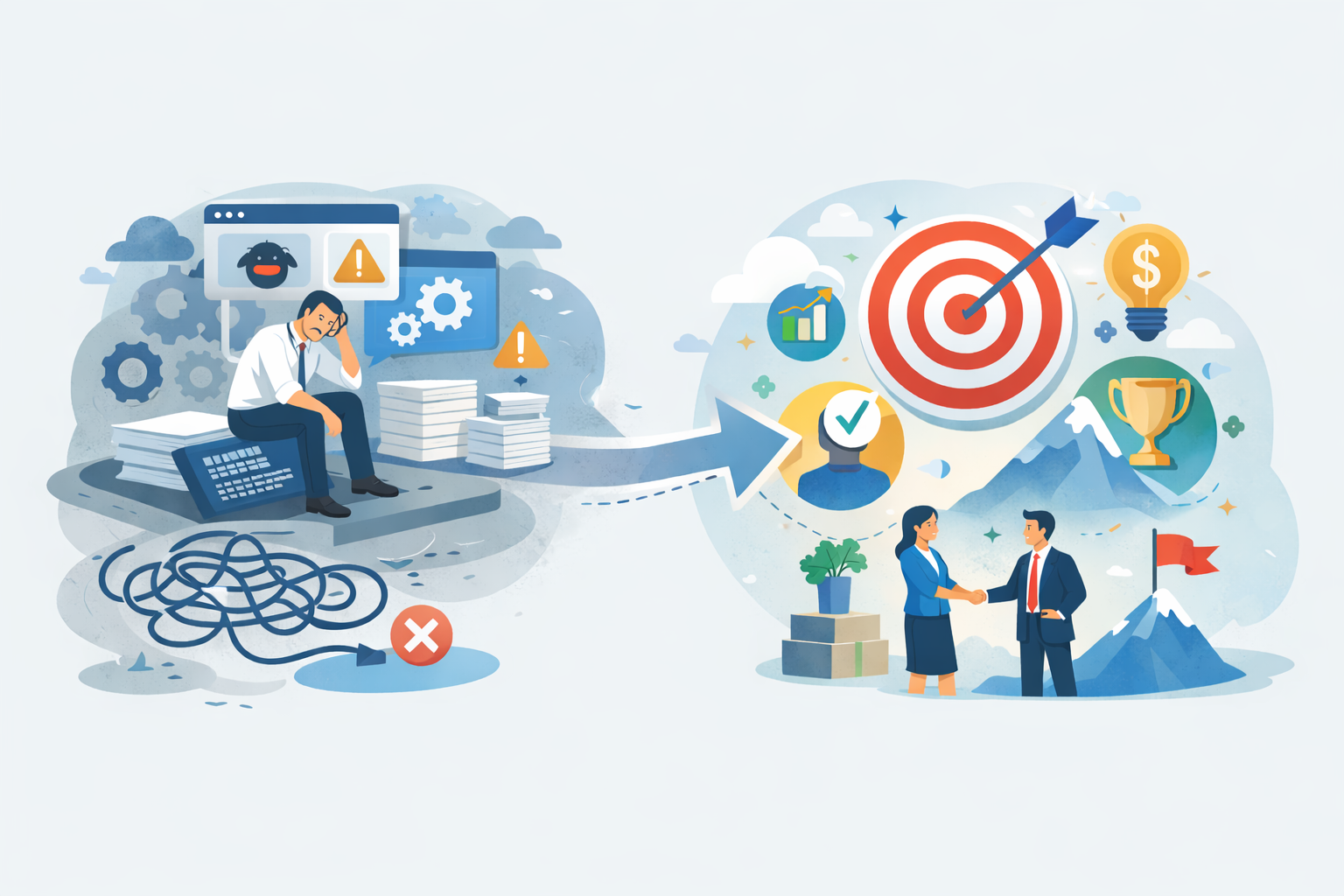
Custom software has a credibility problem. Too often, software is delivered as a finished artifact rather than a finished solution. Features are implemented. Specifications are satisfied. The system technically works. And yet, the business feels no easier to operate than before. The issue isn’t execution. It’s orientation.
Writing code is often treated as synonymous with solving a problem. In practice, code is only a mechanism. Without a clear understanding of how the business actually runs—how decisions are made, where work slows, and what outcomes matter—software simply digitizes existing friction.
Elegant systems can still fail if they’re built in isolation from operations.
Why the Consulting Mindset Changes the Outcome
The most effective systems aren’t designed by teams that start with technology. They’re designed by teams that start with the business.
They ask different questions:
Where does work reliably stall?
Which decisions require the most context—or the most rework?
Where does risk live because processes depend on memory, interpretation, or manual effort?
These questions surface constraints that code alone can’t fix. They reveal where judgment needs to be supported, standards need to be enforced, and information needs to move without translation.
From there, software becomes purposeful. It doesn’t add features—it removes friction. It doesn’t increase activity—it increases leverage.
That’s why the most successful engagements rarely feel like development projects. They feel like operational redesigns, with software as the reinforcing layer. The result isn’t just a system that works—it’s a business that does, too.
Need help getting started and making smart decisions for your business? Talk to us. We have 30 years of experience helping businesses get the most bang for their buck.